the church of the third place
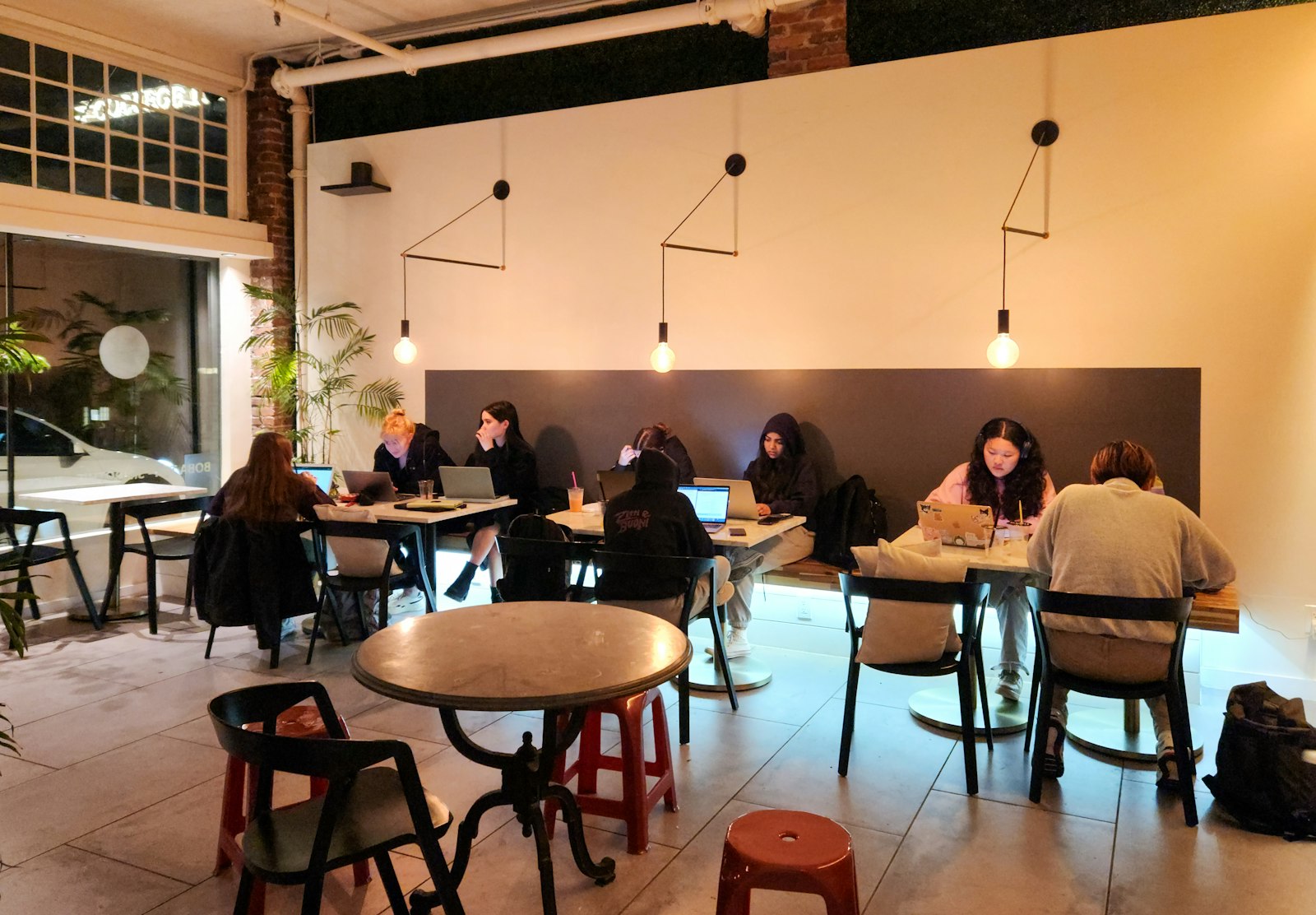
There is a man at Coffeebar on Chestnut Street who has been sipping the same Yuzu Latte for forty-five minutes. His laptop is open, his AirPods are in, his hands are typing. Something is happening. Something that could not happen at his kitchen table, or in the fluorescent study rooms of the Jensen Huang Building on Stanford, or at the co-working space of his seed-stage startup.
He is vibing.
This is the secret liturgy of the Peninsula coffee shop: proximity to productivity. The theater of strangers working alongside strangers, each enclosed in a private bubble that is, paradoxically, sustained by the collective hum around it. The barista calls a name. A chair scrapes. Someone laughs into a phone. And inside this choreography, something loosens in the prefrontal cortex. Ideas arrive sideways.
Ray Oldenburg coined the term "third place" in 1989: the social environment distinct from home (first) and work (second). He was thinking of barbershops and taverns. But he could not have anticipated that the most consequential third place of the twenty-first century would smell like oat milk and single-origin Ethiopian Yirgacheffe.
The stretch of land between Palo Alto and Menlo Park has an unusual relationship with coffee shops, and it is worth understanding why. This is a corridor where the dominant industry is thinking. Stanford sits at one end like a research reactor, leaking graduate students and theories. Sand Hill Road sits at the other, converting those theories into term sheets. And in between, on University Ave and Santa Cruz Ave, the coffee shops serve as the interstitial tissue connecting the two.
The coffee shop is a collision engine.
You sit down at Blue Bottle on Waverley or Verve on University and you are, within arm's reach, adjacent to a PhD candidate debugging a transformer architecture, a second-year Stanford GSB student stress-testing a pitch deck, and a partner from Sequoia taking a meeting that she chose to hold here rather than on the Hill because the informality changes the power dynamics. You do not speak to any of them. You don't need to. Their presence — the sheer density of directed attention — is itself a kind of fuel. Psychologists call it "social facilitation." I call it the reason I can write this piece in one go.
But serendipity is the deeper draw for me. This ecosystem runs on 'weak ties', the sociologist Mark Granovetter's term for the acquaintances or the friends-of-friends. Weak ties are, counterintuitively, more valuable than strong ones for novel information. Your close friends know what you know. The stranger at the next table does not. And the coffee shop is the last unstructured social space where weak ties can still form organically.
I have watched a venture chat begin at Cafe Venetia on University because two people recognized each other's laptop stickers. I have seen two writers meet at Café Borrone in Menlo Park because one overheard the other's phone call and said, "Sorry, are you working on what I think you're working on?"
There is also something deeper at work. The coffee shop offers a particular quality of solitude, what the philosopher Gaston Bachelard might have called inhabited solitude. You are alone, but you are not lonely. You are private, but you are witnessed. The barista who remembers your order, the dog asleep under the table by the window, the founder coding away… they all compose a living wallpaper that reminds your nervous system that you belong to the species.
This matters more than we admit. Remote work liberated millions of people from the commute and the open office. It also severed millions of people from the incidental and unplanned contact that makes a life feel textured. The coffee shop is the patch. A daily minimum dose of being among others that keeps the social muscle from atrophying entirely.
The best coffee shops on the Peninsula understand this intuitively. They leave the Wi-Fi password on the wall, the outlets accessible, the music at a volume that permits both conversation and concentration. They let you stay. The implicit contract is: buy something every couple of hours, don't take a phone call on speaker, and you have purchased a temporary membership in a civilization of strangers.
I am writing this from a corner table at Coffeebar Menlo Park. My oat milk Marzipan latte is great today. The lighting is not needed because it's sunny outside. My friend is across the room who has been working with such focus that it's inspiring. She is my accountability partner. She does not know this. Perhaps she will never know this. And that, I think, is the whole beautiful point.
But remember the guy who was vibing? Who has his AirPods in, who is typing away. Well that guy is me.
The coffee shop asks nothing of you except your presence. And in return, it gives you back the most productive, most serendipitous, most gently human version of your working self. It might, in fact, be the thing that makes us come alive.
Onward,
Abhi